

Welcome to Dialtune!
Whether you just unboxed your first Dialtune snare or you're setting up a full Dialtune kit, you're in the right place. We've put together everything you need to get dialed in fast — from setup and tuning to head changes, cable tips, and troubleshooting.
Select your product below to jump straight to what you need.

How to set up your Dialtune snare
Place the drum on your snare stand with the snare throw-off facing you. If your snare stand isn't wide enough to grab the outer edge of the hoop, you can have it grab the inner flange of the hoop instead.
In this position, the right dial controls the pitch of the top head, while the left dial controls the pitch of the bottom head.

How to tune your Dialtune snare
Dials on either side of the drum independently control the tension of the top and bottom drum heads. Turning clockwise increases tension, counterclockwise lowers tension. Righty tighty, lefty loosey.

How to set up your Dialtune kit
Setting up your Dialtune kit follows the same principles you may already know from our snare, but across every drum in your setup. Start with your kick drum, then toms, then snare. Each drum uses the same cable-tuning system, so once you've got the feel for one, the rest will come naturally.
Kick drum: Position the kick on its spurs and attach your pedal. The dials are designed to sit at the 3-o'clock position on your kit. The dial closest to your kick pedal controls the batter head, and the dial further from you controls the resonant head.
Toms: You have two options to mount your toms. 1) Attach them to a post mount using the universal clamp. Or 2) basket mount your toms. IMPORTANT TO NOTE, you can swap the position of the universal post mount with the badge. We're making a video on how to do that.

Getting started guide
In this video, we walk through unboxing your new kit, tips for setup, tuning, troubleshooting and more.

How to tune your Dialtune kit
The fun of Dialtune's system is that tuning your entire kit works the same way — turn the dial, hear the change, find your sound fast. But here are a few tips for getting your kit sounding cohesive:
Start with the kick. Set your foundation first. Dial the batter head to your preferred attack and feel, then adjust the resonant head for tone and sustain.
Tune toms high to low. Start with your smallest tom and work down. This helps you set intervals between drums so they sing together, not fight each other.
Fine-tune while you play. One of the biggest advantages of Dialtune is that you can make adjustments on the fly. Play a groove, listen, and tweak. No drum key. No stopping. Just turn and dial it in.
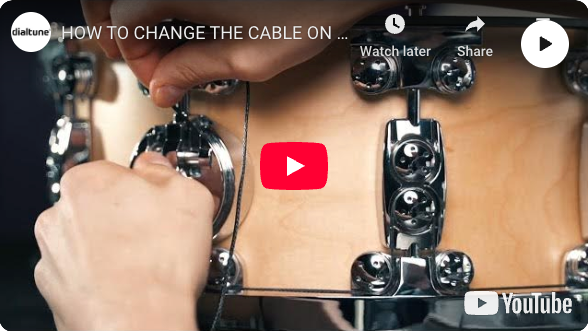
Changing a cable
To change a cable, first follow the directions above to remove a drum head.
Use a 2.5mm hex/allen wrench (Note* Maker Series uses 2mm) to loosen the set screw and remove both dials.
Pull the cable out from the pulleys around the system.
With the old cable removed, insert the new cable into the gear housing, starting on the right side (recommend watching the video if you get stuck).
Loop the cable around the pulleys until you get to the last lug. Skip the last two pulleys and go straight to the left side of the dial housing.
Insert the cable like you did in the beginning and then loop the last two pulleys. Replace the head, replace the hoop, dial to tension.
FAQs
Please read our FAQs page to find out more.
Need help troubleshooting?
Below are some common troubleshooting tips and tricks
I'm struggling to take the hoop off
Try releasing more tension from the system by detuning the dial for the corresponding drum head (turning counter-clockwise).
If you're new to playing a Dialtune snare, it takes a little getting used to knowing how far to back off the tension before the rim easily disengages from the shoulder bolts
I can't get the hoop back on
Similar to how one might need to release more tension to disengage the hoop from the shoulder bolts, if you're struggling to get the head back on - first start by detuning the dial even more for the head you're trying to get the rim back on.
When the system is under tension, the cable pulls the support hoop down which makes it more difficult to re-engage the rim to the shoulder bolts. When you remove tension from the system, you help raise the height of the support hoop making it easier for the shoulder bolts to easily slot into the rim.
The head does not appear to be evenly in tune
If you notice that there is a significant discrepancy in tuning between lug points around the head of the drum, here are a couple things to double check:
- Check the cable at each pulley to make sure it is seated correctly and not caught up somewhere
- With most of the tension released from the system, pull down gently on the cable that spans between each lug point to make sure the support rim is traveling smoothly up and down (the tension needs to be really loose to do this).
- Next, check the drum head for any damage or inconsistency.
- Check the top hoop for any warping by placing it on a level surface (kitchen countertops work well). You should not be able to stick more than one credit card under any side of the hoop when it is sitting level.
- Make sure the bottom head is cranked up tight and the snare wires are properly adjusted.
- Make sure the snare stand basket is not contacting the snare side head
I'm having issues with a dial
Did the dial fall off? or are you struggling to take the dial off? Here are a couple quick tips. On the dial, at the end of the 'e' in Dialtune, there should be a small hole. This is where the set screw is that holds the dial to the post on the dial housing. Using a 2.5mm hex key / allen wrench (or a 2mm for Maker Series), turn the key counter-clockwise to loosen the set screw and clockwise to tighten the set screw. You'll want to make sure the hex key feels seated in the set screw before turning it.
If the dial on your drum fell off, it's likely because the set screw was loose. This is often an easy fix. Reattach the dial, aligning the crescent 'D" of the post to the D shaped hole on the interior of the dial. Then use the appropriate allen key (2.5mm, or 2mm for Maker Series) to turn clockwise and tighten the set screw against the post. We suggest using your other hand to hold the dial on the housing and ensure it's roughly level - so once tightened, and you begin to turn the dial it's not overly angled in any one direction.
Still having issues? Feel free to email us at hi@dialtunedrums.com and we'll jump on the phone with you to troubleshoot!
Drum Kit FAQs
Please read our FAQs page to find out more.
Show me the full specs of the drum set
- SIZES: 8x10" (4-piece), 9x12" rack tom, 14x16" floor tom, 16x22" bass drum
- MATERIAL: 100% North-American maple shells, 8-ply shells made with a stagger seam lamination process
- BEARING EDGE: Off-set double 45-degree to maximize tone and tuning range
- TUNING SYSTEM: Independent dials for batter and reso heads on all drums
- RIMS: Quick-release hoops on rack and floor tom, fast-lugs on bass drum
- TOM MOUNT: Universal 1/2" (12.7mm) tom mount bracket on rack toms for L-post stands
- WEIGHT: 8x10" 10lbs, 9x12" 12lbs, 14x16" 18lbs, 16x22" 22lbs
How are the rack toms mounted?
Both the 8x10" and 9x12" rack toms come with a 1/2" (12.7mm) universal mount that fits most L-rod post stands, including Ludwig, DW, and Gibraltar. The mount is securely attached to the shell by two screws, with a spacer between the mount and the shell. As an option, the mount can be removed and replaced with a badge that covers the holes if you prefer a cleaner look.
Additionally, you can place either rack tom on a snare stand.
Does the entire kit have the ability to tune the top and bottom heads independently?
Yes, the same independent control drummers love on our snares is available on each drum in our Dialtune drum set. You can control the tuning of the batter and reso heads using separate dials. No tools required!
Can I use standard drumheads on a Dialtune drum set?
Yes! Drumheads from major manufacturers like Evans, Remo, Aquarian, Attack will work with Diatlune's cable tuning system. Just make sure you're buying the right size diameter for the drum 🤘🥁
How do I change the cable on a Dialtune tom or bass drum?
Changing a cable on a Dialtune rack tom, floor tom, or bass drum is a simple process and should be part of the regular maintenance you perform on your Dialtune drum set.
We've put together a video to walk you step by step through the process of changing a cable for either the top or bottom drum heads. We'll have How-To videos on how to change cable for each drum soon.
How long will a cable last on the toms or bass drum before I have to replace it?
We use a high-tech, synthetic fiber cable rated at over 500-lbs. Each length comes pre-stretched and carries zero memory, meaning it can be coiled and uncoiled easily without retaining any shape or structure. If you tune your drum to a setting and leave it, the cable should hold for many months, if not years, without needing to be replaced. The more you tune, the more frequently you'll want to check - and if need be - change your cable.
How much does each drum weigh?? And how does it compare?
The weight of each individual tom and bass drum is comparable to premium drum kits from major manufacturers. The approximate weight of each drum is as follows:
- 8x10" 10lbs
- 9x12" 12lbs
- 14x16" 18lbs
- 16x22" 22lbs
How does the Dialtune drum kit perform in different environments?
From small cramped rooms to the largest arenas, we have engineered our drum set to sound great no matter the environment. That is because our cable tuning system helps to provide a clear and consistent tone throughout the tunable range of the drum, even if the temperature and humidity changes.
The cable system pulls each lug point at a consistent tension. And your ability to dynamically hear changes as you tune help you match your tuning to the room faster and easier than every before.
Can I put Dialtune's cable system on my current drum kit?
Not yet. Because of the wide variety of drum manufacturers on the market, each manufacturer uses a unique lug pattern that makes it difficult to apply Dialtune's cable tuning system effectively. To ensure the technology works, we make Dialtune as a complete drum so we can have more control over the quality! We hope to tackle an aftermarket version in the future.